Which Dental Prosthesis is right for you?
A dental prosthesis is a dental appliance that replaces or repair missing or damaged teeth. A dental prosthesis or prosthodontic treatment can improve the aesthetic appearance of your teeth as well as restore and enhance the function of your teeth. There are several types of appliances which include implants, crowns, bridges, dentures and veneers, and some of them can be removable or permanently fixed in your mouth. Some of these procedures are permanently fixed to your mouth, and some are removable.
Types Of Dental Prostheses
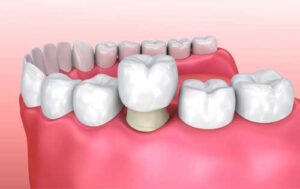
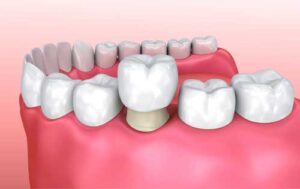
1. Dental Crowns:
Dental crowns are caps put over the tooth if it has been severely damaged by a cavity, accident, or even dental procedures such as a root canal. Dental crowns are often used to restore a single missing tooth or multiple missing teeth that are not adjacent to one another. Dental crowns are available in several materials, such as ceramic, metal, and porcelain.
2. Dental Implant:
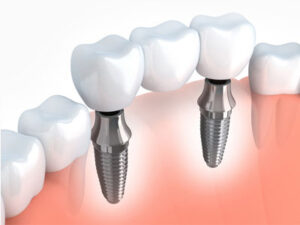
Dental implants are titanium posts surgically placed into the jawbone to serve as artificial tooth roots. They provide a sturdy foundation for replacement teeth, such as crowns, bridges, or dentures. Dental implants offer excellent stability and durability, and they closely resemble natural teeth in appearance and function.
3. Dental Bridge:
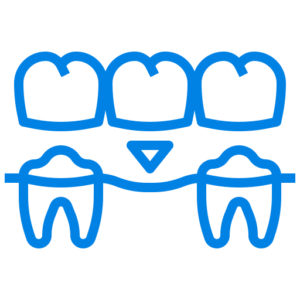
Dental bridges are constructed from two dental crowns joined together by a false tooth or teeth. When one or more teeth are missing, a dental bridge is used between dentures and implants.A bridge is often made of porcelain to look like natural teeth and must be brushed and flossed regularly. Dental bridges are ideal for replacing neighboring teeth that have been lost, decaying, or injured. Bridges can also be used in conjunction with implants, referred to as implant-supported bridges. When natural teeth lack the structural strength to support a dental prosthesis, implant-supported bridges are utilized.
4. Dentures:
Dentures are removable prosthetic devices used to replace multiple missing teeth. They come in two main types:
a) Partial Dentures:
Partial dentures are used when some natural teeth remain in the upper or lower jaw. They consist of replacement teeth attached to a metal or plastic framework that clasps onto the remaining teeth for support.
b) Complete Dentures:
Complete dentures are used when all natural teeth are missing in the upper or lower jaw. They consist of a full set of artificial teeth set into a pink, gum-colored acrylic base that rests directly on the gums.

5. Dental Veneers:
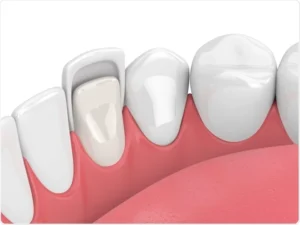
Dental veneers are thin shells, usually made of porcelain, that are bonded to the front surface of teeth to improve their appearance. They are used to correct issues such as discoloration, chips, cracks, or gaps between teeth. Veneers provide a natural-looking and durable solution for enhancing the smile’s aesthetics.
What is Dental Prosthesis Made of?
Porcelain is a ceramic material prized for its natural appearance and ability to mimic the
translucency of natural tooth enamel. It is commonly used for dental crowns, veneers, and
bridges in the visible areas of the mouth.
Acrylic resins are often used in the fabrication of dentures, both partial and complete. These
materials are lightweight, easy to adjust, and can be customized to match the natural
appearance of the gums and teeth.
Metal alloys are frequently utilized in partial dentures or crowns. Metal alloys may be
exceedingly robust and durable, withstanding chewing and biting pressures.
Composite resins are tooth-colored materials composed of a mixture of plastic and glass or
ceramic particles. They are used in direct restorations such as dental fillings and bonding
procedures, as well as in indirect restorations like veneers.
Zirconia is a type of ceramic material known for its exceptional strength and biocompatibility.
It is commonly used in dental crowns, bridges, and implant restorations, particularly in cases
where high strength and durability are required.
All types of dental prosthesis and prosthodontics are convenient and beneficial. If done by a
skilled Dentist, Getting a dental prosthesis device can be a life-changing decision. A dental
prosthesis can improve your smile and how you feel about your appearance, improve your
oral health, and avoid problems related to nutrition, digestion, gum disease, and the loss of
jawbone material.
Notifications
- Circular for Clinic Timings – Janmashtami Festival
 Circular for Clinic Timings – Janmashtami Festival Dentistium Multispeciality Dental …
Read More "Circular for Clinic Timings – Janmashtami Festival"
- Important Announcement: Revised Clinic Timings for Rakshabandhan Festival
 Important Announcement: Revised Clinic Timings for Rakshabandhan Festival DENTISTIUM MULTISPECIALITY …
Read More "Important Announcement: Revised Clinic Timings for Rakshabandhan Festival"
- DENTISTIUM Multispeciality Dental Clinic is Now Officially Empaneled with BSNL
 DENTISTIUM Multispeciality Dental Clinic is Now Empaneled with BSNL We …
Read More "DENTISTIUM Multispeciality Dental Clinic is Now Officially Empaneled with BSNL"
Recent Posts
- 🦷 How Veneers Can Help Close Gaps Between Teeth
 How Veneers Can Help With Gaps in Teeth: A Complete GuideA gap between the …
 - 🦷 Dental Fillings: Restore Your Tooth, Preserve Your Smile
 🦷 Dental Fillings: Restore Your Tooth, Preserve Your Smile A cavity doesn’t have to change the …
Read More "🦷 Dental Fillings: Restore Your Tooth, Preserve Your Smile"
- How Can You Close a Gap Between Your Teeth?
 A gap between two teeth can be a natural feature, …


Experience powerful oral care with the PRO200V PORCLEAN Water Flosser....